
Free Shopify themes vs Premium: When should you upgrade? (2026)
If you’re weighing free Shopify themes vs premium in 2026, this isn’t really a design decision. It’s an infrastructure one. Free themes like Dawn and the newer Horizon collection are genuinely good starting points. But once you’re scaling, running real paid traffic, managing a growing catalog, stacking apps to fill gaps, premium themes start solving problems that free themes quietly create.
Table of Contents
TL;DR
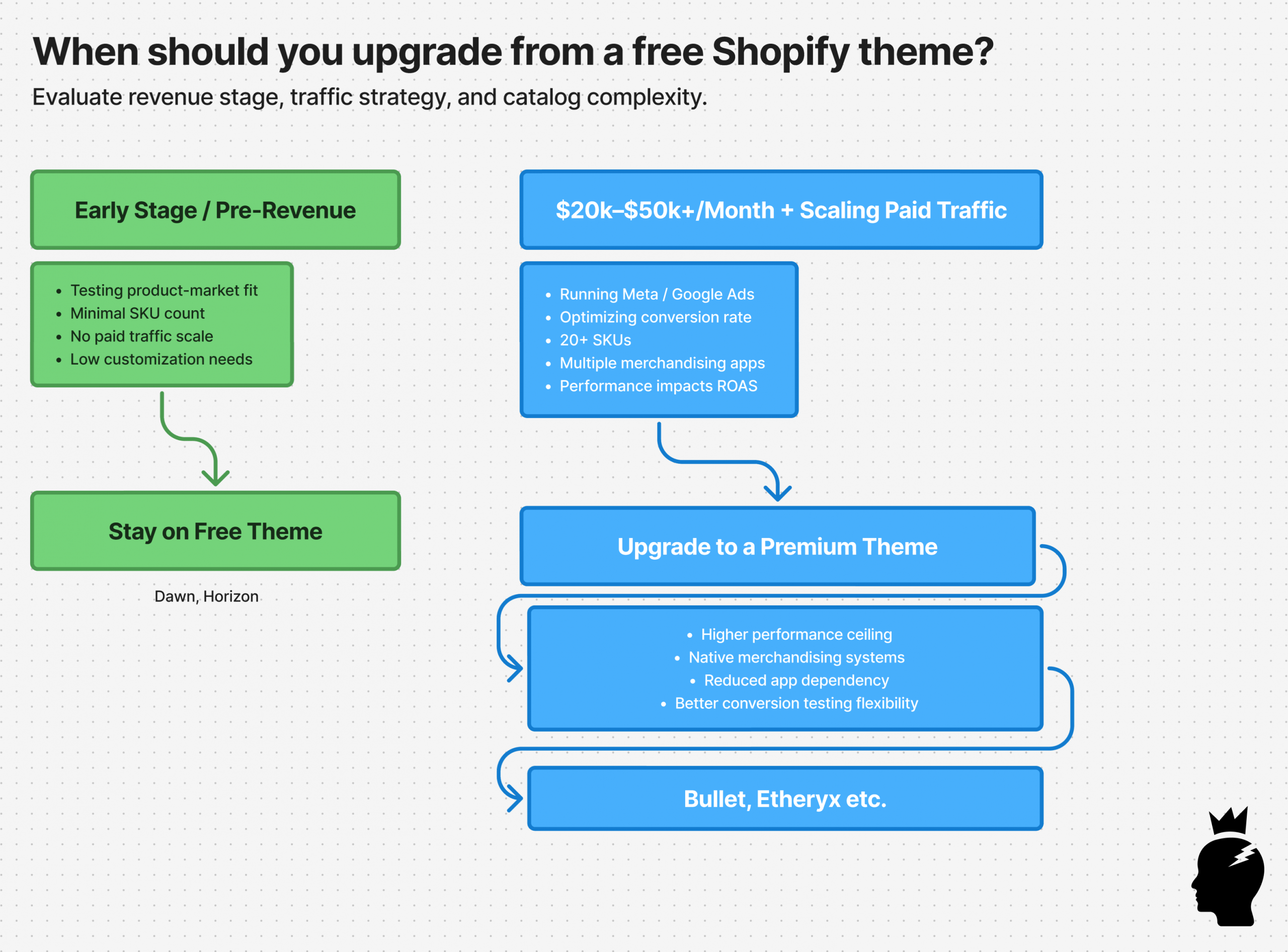
- Best free baseline: Dawn plus the Horizon free theme collection (Horizon, Dwell, Savor, Fabric, Atelier, Ritual, Tinker, Heritage, Vessel, Pitch). Use these while you’re still figuring out what sells (Dawn listing, Horizon collection).
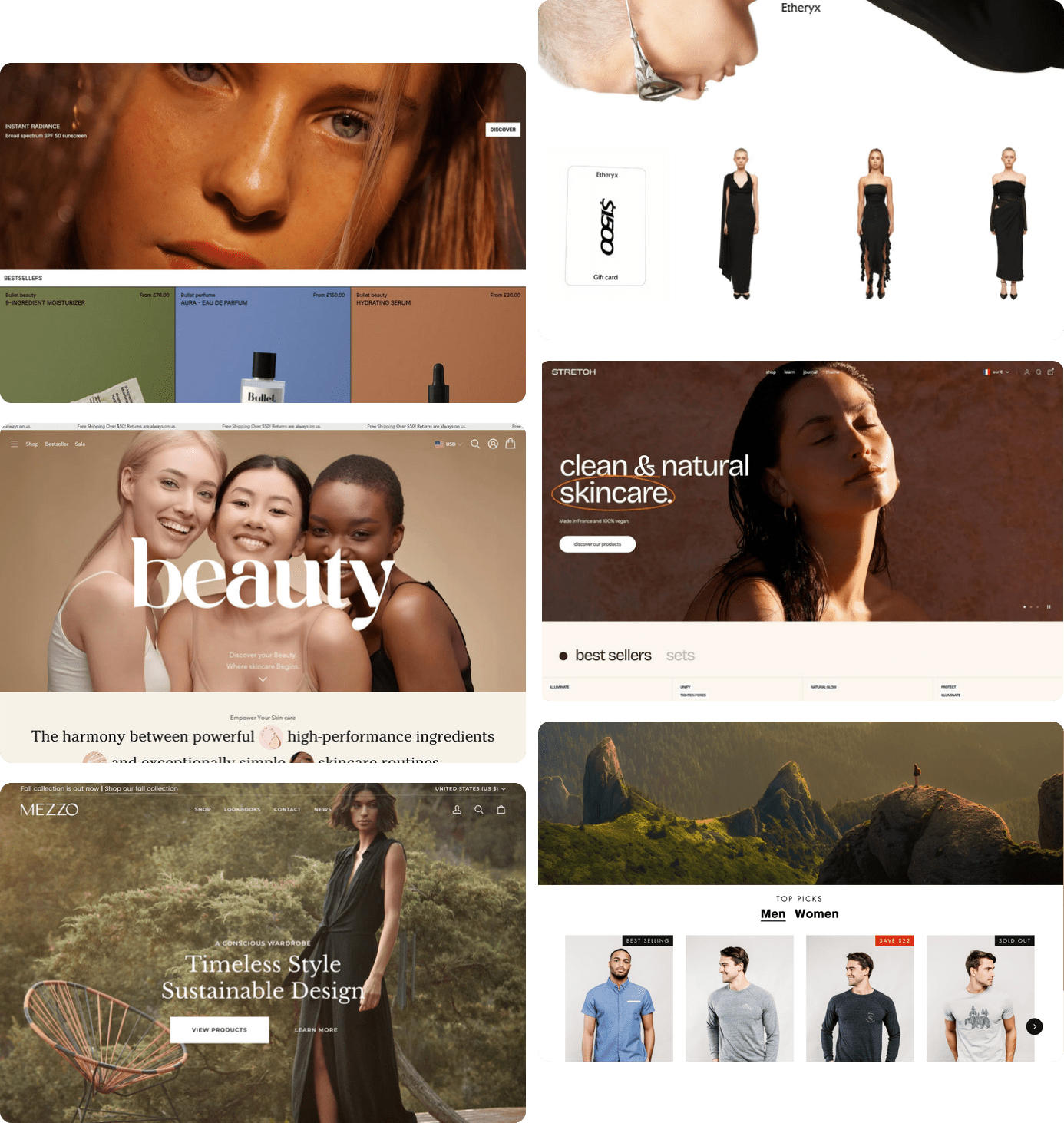
- Best premium for scaling brands: Bullet and Etheryx, especially if your app stack is getting heavy and you need performance headroom. Bullet presets: Aeris, Bull, Etch, Nox (Bullet). Etheryx presets: Ethereal, Ethernity (Etheryx).
- Best for big, complex catalogs: Enterprise or Impulse, when navigation and collection mechanics are the real bottleneck (Enterprise).
- When to upgrade: $20k-$50k/month revenue with active paid traffic, 20+ SKUs with real merchandising needs, 4+ CRO/UX apps stacked, international expansion, or active conversion testing.
- A note on performance data: Shopify Performance and Theme Vitals are aggregated datasets from real stores. They’re useful for understanding headroom, not for predicting your exact score. Your apps, media, and custom code all shift the outcome (Shopify Performance dataset, Theme Vitals methodology).
What free themes actually do well
I want to be upfront about something: Shopify’s free themes in 2026 are not the afterthought templates they were a few years ago. They’re clean, well-architected, and compatible with most of what Shopify ships. Dawn is still the go-to default (Dawn), and Shopify’s Horizon collection added 10 new free themes to give merchants more layout variety without paying anything (Horizon themes collection).
If you’re early-stage, a free theme is probably the right call. And I don’t mean that as a consolation prize.
Zero cost, zero commitment
Pre-revenue or just crossing your first consistent month? You have bigger problems than your theme. Offer clarity, creative testing, acquisition basics, that’s where your time goes. A free theme keeps the decision reversible while you figure out what actually makes people buy. Nobody ever failed because their theme cost $0.
Clean architecture and predictable upgrades
Free themes tend to ship fewer “opinionated” features. That’s actually a benefit when you’re starting out. A simpler codebase is easier to debug, and fewer embedded features means fewer edge cases when you install your first batch of apps, reviews, email capture, analytics, shipping messaging. You don’t want complexity before you need it.
Aligned with Shopify’s platform direction
Shopify’s Theme Store messaging leans into regular updates and compatibility, the idea that themes are “future ready” (Shopify Theme Store). In practice, free themes track Shopify’s platform changes closely. They’re safe defaults, and there’s nothing wrong with safe defaults at the right stage.
Horizon gives you more starting shapes
This is the part people miss. Horizon isn’t one theme, it’s a system with 10 styles: Horizon, Dwell, Savor, Fabric, Atelier, Ritual, Tinker, Heritage, Vessel, and Pitch (Horizon collection). Why does that matter? A lot of merchants upgrade too early just to escape a layout that doesn’t fit their category. Start closer to your target structure and you skip an unnecessary migration.
Where free themes start to break down
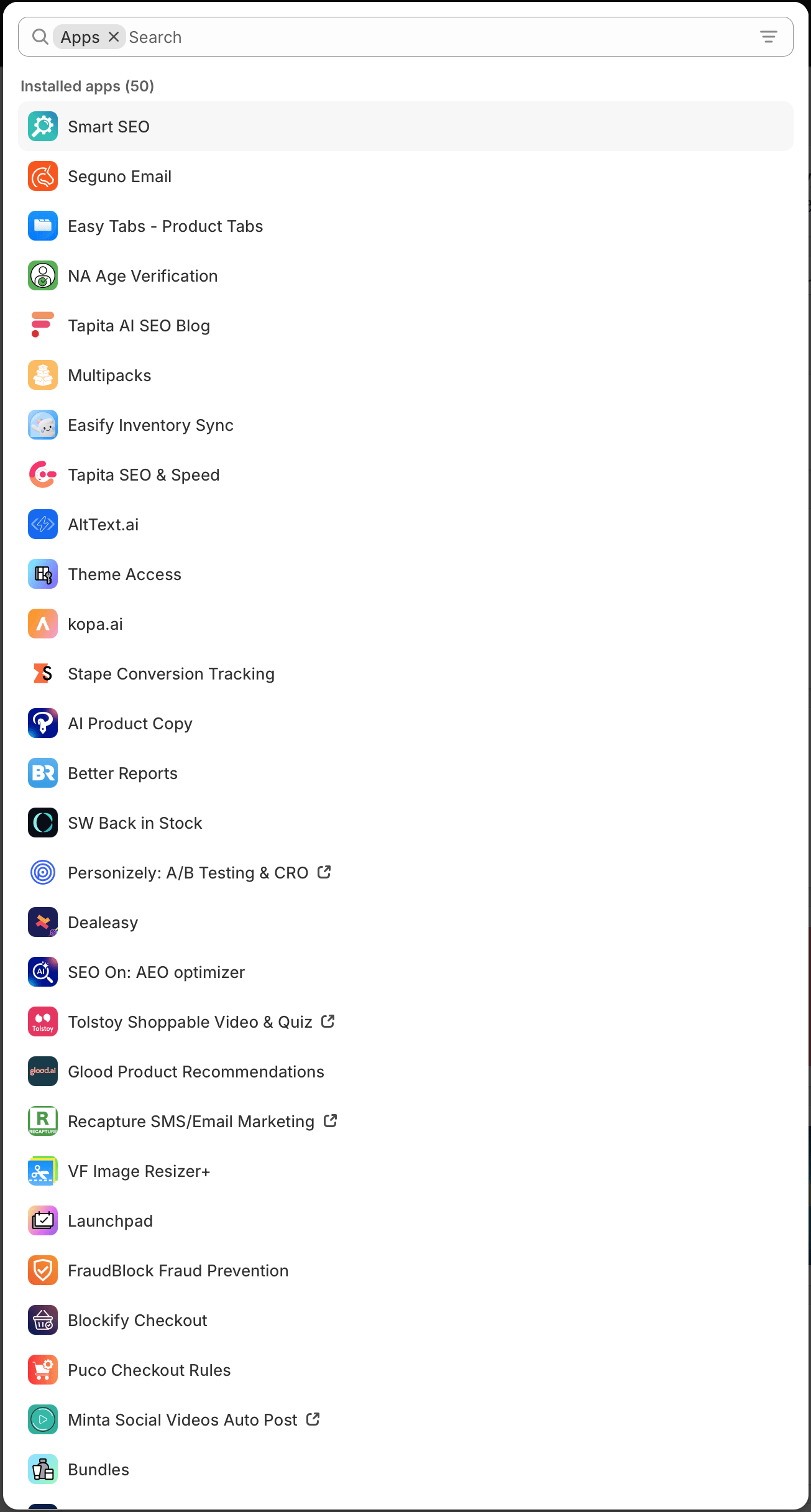
Free themes rarely fail at launch. The problems surface later. Your store becomes a system with dependencies, apps, tracking, international markets, merchandising rules, frequent content changes, and at some point the question stops being about design. It becomes about operational load and conversion efficiency.
App layering turns into structural debt
I see this pattern constantly. Merchant starts with a free theme because it’s lean. Then they bolt on apps to fill gaps: tabs, sticky add-to-cart, upsells, bundles, swatches, a delivery estimator, maybe more. Each one seemed reasonable on its own. Collectively, they become a problem.
Shopify says as much, real store performance depends on the theme and the apps and custom code layered on top (Shopify Performance notes).
The compounding costs are: performance overhead from more scripts, CSS, and network requests; UX fragmentation from inconsistent buttons, spacing, and typography across vendor widgets; and maintenance overhead from vendor conflicts, duplicated event listeners, and theme updates that require retesting everything. None of these are catastrophic individually. Together they grind you down.
The product page becomes the bottleneck
Most theme upgrades happen because the product page (PDP) runs out of room. As your catalog grows, you need richer structure: better product storytelling, structured specs, comparison blocks, bundles, trust signals close to purchase intent. Free themes can handle some of this. But the more you rely on third-party widgets to build the PDP, the more brittle the whole system gets. And brittle systems break at the worst times, like during a sale when traffic spikes.
CRO gets slow and expensive
Once you start taking conversion optimization seriously, the bottleneck becomes iteration speed. Can you change a layout without touching code? Can you run an A/B test on PDP structure without installing another app? A theme that makes these things easy lets you test faster. When every experiment requires custom sections or app add-ons, your testing cycle slows down and costs more. That math matters a lot when you’re spending real money on ads.
Performance drifts down over time
Even a fast baseline erodes as you add media, tracking scripts, and features. Shopify publishes aggregated theme performance data specifically because no theme can guarantee your numbers, it’s about showing directional trends across real stores (Shopify theme performance dataset). What starts as a 95+ CWV pass can quietly drift into the 80s if you’re not watching.
International scaling exposes content gaps
Going international adds complexity fast: region-specific shipping and returns copy, localized navigation, currency and tax presentation, market-specific product assortments. If your theme relies on scattered widgets and heavy custom logic, the translation and market rollout workflow slows to a crawl. Shopify’s Web Performance reports can help track how these storefront changes affect real users (Shopify Web Performance reports).
Theme updates create friction
Updates are good. They’re also work. If your store has customizations, each update is a project: QA across templates, verifying app integrations, validating conversion-critical flows. Shopify’s dataset references the importance of running recent theme versions, falling behind increases risk (Shopify dataset methodology notes). The irony is that the more customized your free theme, the harder it is to keep it current.
Support and accountability differ at scale
Free themes don’t come with a premium support relationship. Fine when you’re small. At scale, when something breaks in checkout-adjacent UX, cart drawer, sticky ATC, variant selection, you either self-diagnose or hire help. Premium themes don’t eliminate bugs, but they usually offer faster vendor support and structured changelogs. You can see release histories on theme listings like Bullet and Etheryx (Bullet listing, Etheryx listing).
“Vibe-coded” customizations don’t scale
We all know how this goes. A few quick edits, copied snippets, one-off CSS overrides, untracked script tags, work fine when traffic is low. At scale, undocumented changes become operational risk. Unexpected behavior across devices. Layout shifts you can’t reproduce. Regressions every time an app updates. The more your theme looks like a patchwork, the more expensive growth gets.
When upgrading actually makes sense (a measurable framework)
A theme upgrade is rational when the theme itself is a bottleneck to profitable scaling. Not before. The upgrade signals worth paying attention to are things you can actually measure.
Upgrade becomes rational when:
- You’re doing $20k-$50k/month and paid traffic (Meta, Google, TikTok, affiliates) is a primary acquisition channel.
- You have 20+ SKUs with real merchandising complexity, variants, bundles, cross-sells, category logic.
- You’ve installed 4+ CRO/UX apps to compensate for features your theme doesn’t have.
- International expansion is active or planned, multiple markets, languages, regional content.
- You’re running frequent PDP and collection adjustments, landing page tests, content experiments.
Why $20k-$50k/month is a real tipping point
Below this range, your highest-leverage work is usually product-market fit and learning how to acquire customers profitably. Spend your time on the offer, not the storefront. Above this range, paid traffic is typically a core growth channel. Small changes in conversion efficiency materially affect your CAC and contribution margin. A theme that holds you back at this stage costs you money every day, you just don’t see it on a line item.
When should you upgrade your Shopify theme?
If you searched “when to upgrade Shopify theme” or “should I upgrade my Shopify theme,” here’s the decision logic without the hand-waving.
Upgrade now if 3 or more apply:
- You’re consistently above $20k/month and paid traffic is a primary channel.
- Your product page needs more than a basic gallery + description + reviews.
- You’re running 4+ CRO/UX apps (tabs, sticky cart, upsells, swatches, bundles, shipping estimators).
- You need better collection merchandising, filter UX, promo tiles, grid controls.
- You’re expanding internationally and need scalable content workflows.
- Your team spends more time maintaining theme patches than shipping growth work.
- Your performance trend is drifting down and fixing it feels like constant firefighting.
Stay on a free theme for now if most of these fit:
- You’re pre-revenue or early revenue and still validating demand.
- Fewer than ~20 SKUs and low variant complexity.
- Minimal app stack.
- Your main bottleneck is product-market fit, not storefront iteration.
Performance and Core Web Vitals: how to actually read the data
Performance comes up in every free-vs-premium discussion, and it’s commonly misused. I see merchants quote a CWV score from a demo store as if that’s what their store will get. That’s not how it works.
Treat theme performance metrics as directional evidence about headroom, not a promise. Shopify says this directly, apps and customizations influence outcomes, which is why aggregated theme performance data exists in the first place (Shopify Performance dataset).
Dataset #1: Shopify Performance (aggregated store data)
Shopify publishes theme performance outcomes based on real stores running recent versions. Useful because it reflects actual production usage, not demo stores with zero apps. The framing is conservative: outcomes depend on the theme plus the rest of your stack (Shopify theme performance table).
Dataset #2: Theme Vitals (CrUX field data)
Theme Vitals compiles Chrome UX Report (CrUX) field data by theme. It’s real-user performance at scale, and the site explicitly recommends comparing theme baselines to your storefront to detect app or customization drag (Theme Vitals).
Shopify’s Web Performance reports
These show your store’s Core Web Vitals trend over time and help you connect changes with storefront events, an app install, a theme update, a code change (Web Performance reports, Improving web performance). This is the right tool for decision-making because it reflects your actual store, not an average.
Where Bullet and Etheryx fit
Bullet and Etheryx are premium themes by OpenThinking. The idea behind both: performance-first foundations paired with deep built-in merchandising, so you don’t need to lean on heavy app layering for the features you need (Bullet on Shopify, Etheryx on Shopify).
Bullet currently shows ~96.9% mobile CWV pass in Theme Vitals (Bullet on Theme Vitals). Etheryx is $360 with a public changelog (Etheryx listing). For newer or lower-adoption themes, treat early Theme Vitals reporting cautiously, rely on your own Web Performance trend for validation.
Your media, apps, tracking, and custom code can push outcomes above or below theme baselines. These numbers are directional, not guarantees.
Shopify themes compared: free vs premium (2026)
If you’re searching “premium Shopify themes,” “paid Shopify themes,” or “best premium Shopify themes 2026,” this table covers the main options across the dimensions that actually matter at scale.
| Theme | Price | Type | Built-in merchandising | App dependency to fill gaps | Performance baseline | Best for |
|---|---|---|---|---|---|---|
| Dawn | Free | Free | Basic | High — most merchandising features require apps | Strong baseline; degrades with app layering | Early-stage stores, validation phase, light SKU count |
| Horizon collection | Free | Free | Basic | High — same tradeoffs as Dawn | Strong baseline; degrades with app layering | Early-stage stores that need more layout variety than Dawn offers (10 styles) |
| Bullet | $370 | Premium | Deep — upsells, cross-sells, modular PDP blocks, collection controls built in | Low — replaces several CRO and merchandising apps | ~96.9% mobile CWV pass rate (CrUX field data via Theme Vitals) | Scaling brands on paid traffic; active CRO; app stack reduction |
| Etheryx | $360 | Premium | Deep — structured, product-forward layouts with clear information architecture | Low — built for product-heavy verticals without heavy app reliance | Strong; treat early Theme Vitals data cautiously for newer themes | Fashion, beauty, lifestyle, home goods; utility-first product presentation |
Performance figures are aggregated from real-store field data. Your apps, media, and custom code all shift the outcome. See Shopify Performance and Theme Vitals for methodology.
Total cost of ownership: why “free” often gets expensive
The theme price is the line item everyone sees. Total cost of ownership is what you actually pay over time, in apps, developer hours, performance trade-offs, and maintenance. This is why “is a premium Shopify theme worth it?” gets a different answer depending on your stage.
App costs (and the hidden performance tax)
A lot of merchants end up recreating premium functionality through app stacks. The usual suspects: tabs and accordions for structured PDP content, variant swatches, sticky add-to-cart or cart drawer, upsell and cross-sell widgets, bundle builders, sliders or shoppable video blocks, shipping estimators, filtering upgrades.
Each app might cost “only $10-$30/month,” but the stack adds up. More importantly, many of these apps ship their own JavaScript and style bundles that affect real-user performance. Shopify encourages monitoring this via Web Performance reports (Shopify Web Performance reports). I’ve seen stores running $150+/month in apps that a better theme would have replaced entirely.
Developer time and the cost of “small changes”
A “small” theme change is rarely small at scale. You pay for debugging app conflicts and duplicated scripts. You pay for updating theme versions without breaking anything. You pay for maintaining custom sections across templates, and rebuilding features after platform changes. These hours are invisible on a P&L unless you’re tracking them, but they’re there.
Performance trade-offs become ad spend waste
If paid traffic is your growth channel, performance headroom matters. Shopify’s guidance positions Web Performance reports as a way to measure how real users experience your store (Improving web performance). When performance regresses, CAC efficiency gets worse. You’re paying the same for clicks that convert less. That’s the part merchants often miss, slow pages don’t just hurt SEO. They waste ad budget.
A simple ROI example
Say you spend $20,000/month on paid traffic. If a theme upgrade reduces app dependency and friction enough to lift conversion rate by even 0.1 percentage points, that change can affect your contribution margin more than the one-time theme cost. The point isn’t to assume a lift. It’s to choose a theme that removes your actual bottleneck, then validate with your Web Performance trend and conversion data.
PDP capability: why built-in depth matters more than raw speed
Performance matters. But it’s rarely the only reason, or even the main reason, a theme upgrade pays back. For most scaling brands, the bigger payoff is PDP capability depth: fewer dependencies, cleaner layout control, faster iteration. This is where premium themes actually separate from free ones, and it’s less sexy than a CWV score but more impactful on revenue.
Modular blocks that work as a system
Good themes aren’t just “more blocks.” They ship blocks that behave consistently, spacing rules, typography alignment, predictable layout stacking. That reduces the need for custom CSS and makes layout instability across devices less likely. It sounds boring. It saves a lot of time.
Native upsell surfaces without script stacking
Upsells and cross-sells aren’t one widget. They’re multiple touchpoints: PDP, cart drawer, collection page, post-purchase. Premium themes with native merchandising surfaces can cover all of these without adding third-party scripts for each one. That keeps UX consistent and your script count manageable.
Structured content without a tab graveyard
Tabs are convenient. They’re also a crutch. Excessive tab stacks bury buying information and add script dependencies. Strong premium themes let you lay out specs, benefits, guarantees, and comparisons without forcing everything into a single container. That’s a real difference when you’re trying to move people through a purchase decision.
Collection merchandising controls
Once your store grows, collection pages become landing pages. Premium themes built for scale tend to have stronger controls for grid layout, promo tiles, and navigation, especially important for large catalogs. Enterprise is positioned specifically for this (Enterprise listing).
How Bullet and Etheryx approach this
Both themes are designed around the same problem: merchants who want performance headroom and deeper merchandising without heavy app layering. Bullet leans into performance-first design with four presets (Aeris, Bull, Etch, Nox) (Bullet). Etheryx leans into structured, product-forward layouts with three presets (Ethereal, Ethernity) (Etheryx). Different emphasis, same philosophy.
Bullet is one of the fastest premium Shopify themes currently available, with stronger built-in merchandising depth than most alternatives (Theme Vitals: Bullet).
Decision framework: pick the right path for your stage
Choose Dawn or Horizon if:
- You’re pre-revenue or early revenue
- Still validating product-market fit (offer, pricing, positioning)
- Minimal SKU count and low variant complexity
- Light app stack, reviews, email capture, analytics, not much else
Dawn is a dependable free baseline (Dawn), and Horizon gives you 10 free options (Horizon collection).
Choose Bullet if:

- You’re scaling and paid traffic is a primary acquisition channel
- You’re actively testing and optimizing conversion rate
- You want to cut your app count for merchandising and CRO features
- Performance headroom alongside deeper built-in features matters to you
Bullet is a $370 premium theme by OpenThinking (Bullet listing) with strong CrUX-based mobile pass data (Bullet on Theme Vitals).
Choose Etheryx if:
- You run a structured, product-heavy vertical
- You prefer utility-first layouts over editorial-heavy composition
- Clean information architecture for product clarity is the priority
- Common fits: fashion, beauty, lifestyle, home goods, office, bags
Etheryx is $360 on the Theme Store with three presets (Etheryx listing).
Choose Enterprise or Impulse if:
- Your catalog is large and operationally complex
- Navigation, promotions, and collection mechanics are the growth lever
- Scale behavior matters more than aesthetics right now
Enterprise is positioned as a scale theme (Enterprise listing).
Frequently asked questions
Is a premium Shopify theme worth it?
Yes, when your store is scaling and the theme reduces app dependency, maintenance overhead, and conversion friction enough to pay back the one-time cost. Validate with Shopify’s Web Performance reports and your conversion metrics (Shopify Web Performance reports).
Is Horizon replacing Dawn?
No. Horizon is a newer free collection (10 themes) that gives merchants more free starting points. Dawn is still a core free baseline (Horizon collection, Dawn listing).
Do Core Web Vitals matter for SEO?
Yes. They’re page experience signals tied to real-user UX. They become strategically important when paid traffic and competition make performance headroom economically meaningful. Shopify provides Web Performance reports to track CWV trends (Shopify Web Performance reports).
Can a free theme perform as well as a premium one?
Early on, yes, especially with a light app stack. Performance tends to diverge over time as apps, tracking, and custom code pile up. That’s exactly why Shopify frames theme performance as aggregated and dependent on the full storefront stack (Shopify Performance dataset).
When should I upgrade my Shopify theme?
When you’re scaling paid traffic, using 4+ CRO/UX apps, managing 20+ SKUs with merchandising complexity, expanding internationally, or actively running conversion optimization. At that point, a premium theme is infrastructure, not decoration.
How much do premium Shopify themes cost?
Most premium Shopify themes are a one-time purchase ranging from roughly $180 to $400. Bullet is $370 and Etheryx is $360, both sold through the Shopify Theme Store. Unlike app subscriptions, it’s a single upfront cost that includes future updates (Bullet listing, Etheryx listing).
What is the difference between Bullet and Etheryx?
Both are premium themes by OpenThinking built to reduce app dependency while maintaining strong performance. Bullet is performance-first with four presets (Aeris, Bull, Etch, Nox) — best for scaling brands on paid traffic who need deep CRO and merchandising features built in (Bullet). Etheryx uses structured, product-forward layouts with two presets (Ethereal, Ethernity) — fits fashion, beauty, lifestyle, and home goods brands where information architecture and product clarity are the priority (Etheryx).
Is Dawn a good Shopify theme in 2026?
Yes, for early-stage stores. It’s clean, well-maintained, and tracks Shopify platform changes closely. The limitations surface as you scale: the feature set is basic enough that app layering becomes necessary, and performance can drift as that stack grows. For stores past the validation phase with active paid traffic and real merchandising needs, a premium theme is a more efficient foundation.
Upgrade when the theme is the bottleneck
If you’re past $20k/month, running paid traffic, and stacking apps to fill gaps your theme should cover natively — that’s the signal. The theme isn’t a design decision at that point. It’s a cost center.
Bullet and Etheryx are built specifically for that transition: performance headroom, deep built-in merchandising, and fewer third-party dependencies.
- Explore Bullet — performance-first, deep CRO and merchandising features, four presets
- Explore Etheryx — structured, product-forward layouts for fashion, beauty, lifestyle, and home
More posts
- Free Shopify themes vs Premium: When should you upgrade? (2026)
- Best Shopify Theme for Beauty Brands (2026 Guide)
- Which is the best theme in Shopify?
- Etheryx: The Ultimate Premium Shopify Theme
- 10 Things Your Shopify Store Needs to Convert in 10 Seconds
- International E-commerce Expansion: How to Take Your Shopify Store Global


