
Best Shopify Theme for Beauty Brands (2026 Guide)
Shopify has a lot of themes. If you sell skincare, cosmetics, fragrance, or anything wellness-adjacent, picking one feels like it should be simple, but it isn’t. Your theme affects page speed, how trustworthy your store looks, how well you can merchandise products on mobile, and how much technical mess you inherit as you grow.
If you are searching for the best Shopify theme for beauty products, this is the shortlist I would actually use if my revenue depended on it.
Beauty is harder than most categories. Shoppers want big images, ingredient breakdowns, shade swatches, tutorials, routine builders, and social proof, and they want all of it without the page feeling slow or cramped. The best beauty theme isn’t the prettiest demo. It’s the one that holds up when you actually load it with real products, real content, and real apps.
This guide compares Shopify themes beauty brands are actually choosing in 2026, using current public data from Shopify Performance, Theme Vitals, and the Shopify Theme Store. These numbers shift as themes get updated and merchants change their setups, so treat them as directional.
Table of Contents
Quick version
If you just want a recommendation: Sense (Dawn) is the simplest free starting point. Pitch (Horizon) is the better free option if you want beauty-friendly features out of the box.
And Bullet is the premium theme I’d point most serious beauty brands toward right now, because it pairs strong real-world speed with native merchandising tools that actually matter for this category.
Why does the theme matter so much for beauty?
Beauty shoppers decide based on how the product looks, whether they trust the brand, and whether they can find the information they need on their phone. That puts more pressure on a theme than a typical ecommerce store.
A good beauty theme needs to handle ingredient and benefit storytelling, rich product page media and swatches, mobile purchase UX that doesn’t feel clunky, routine-building and cross-sells, trust signals without visual noise, and solid performance even when the page is heavy with content.
Google’s Core Web Vitals recommendations matter here too. Shopify’s own performance documentation is blunt about this: at scale, a well-optimized base theme is the biggest single factor in final store performance. Apps and customizations layer on top of that foundation, and they can erode it fast. See Shopify’s theme performance methodology for more detail.
How the themes actually compare
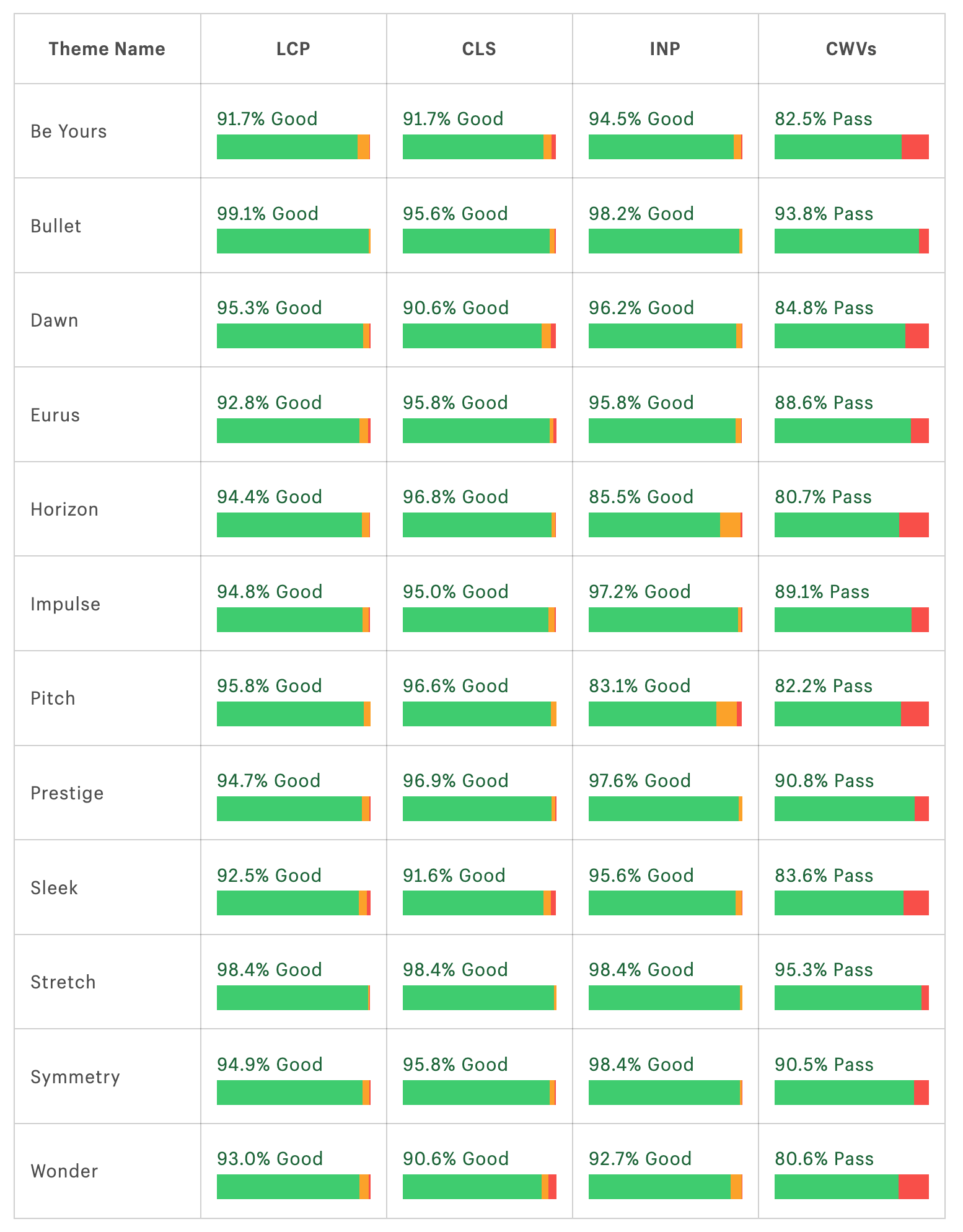
| Theme | Price | Shopify Performance CWV pass rate | Theme Vitals mobile CWV pass rate | Takeaway |
|---|---|---|---|---|
| Bullet | $370 | 93.8% | 96.9% | Best mix of speed and beauty merchandising with fewer apps needed |
| Sense (Dawn) | Free | 82.7% | 82.8% | Simple, safe, well-documented free starting point |
| Pitch (Horizon) | Free | 82.2% | 92.0% | Best free option for beauty storytelling |
| Vogue (Prestige) | $400 | 90.8% | 92.4% | Luxury editorial look tailored to beauty/wellness; expect more performance trade-offs than Bullet. |
| Ceramide (Hyper) | $400 | 76.3% | 80.9% | Built for scaling beauty catalogs with bundles and upsell sections baked in. |
| Phenomena (Palo alto) | $420 | 76.0% | 70.2% | Premium editorial layout for skincare brands that lead with content and education. |
| Be yours | $350 | 82.5% | 81.2% | Common shortlist pick, noticeably behind on performance |
| Wonder | $390 | 80.6% | 69.9% | Nice looking, weaker performance numbers right now |
| Sleek | $350 | 83.6% | 75.9% | Stylish but clearly behind on CWV data |
| Eurus | $350 | 88.6% | 83.2% | Decent choice, Bullet still faster |
| Stretch | $400 | 95.3% | 95.7% | Elite raw speed; validate native beauty PDP UX (swatches, metafield tabs, routine blocks) so you don’t lose speed to apps. |
A note on methodology: Shopify Performance and Theme Vitals measure different things differently. Shopify aggregates 7 days of real-user data across devices and recent theme versions. Theme Vitals uses Chrome UX Report data and breaks out device-specific trends. Neither is “the answer.” Use both to triangulate.
Why Bullet works well for beauty specifically
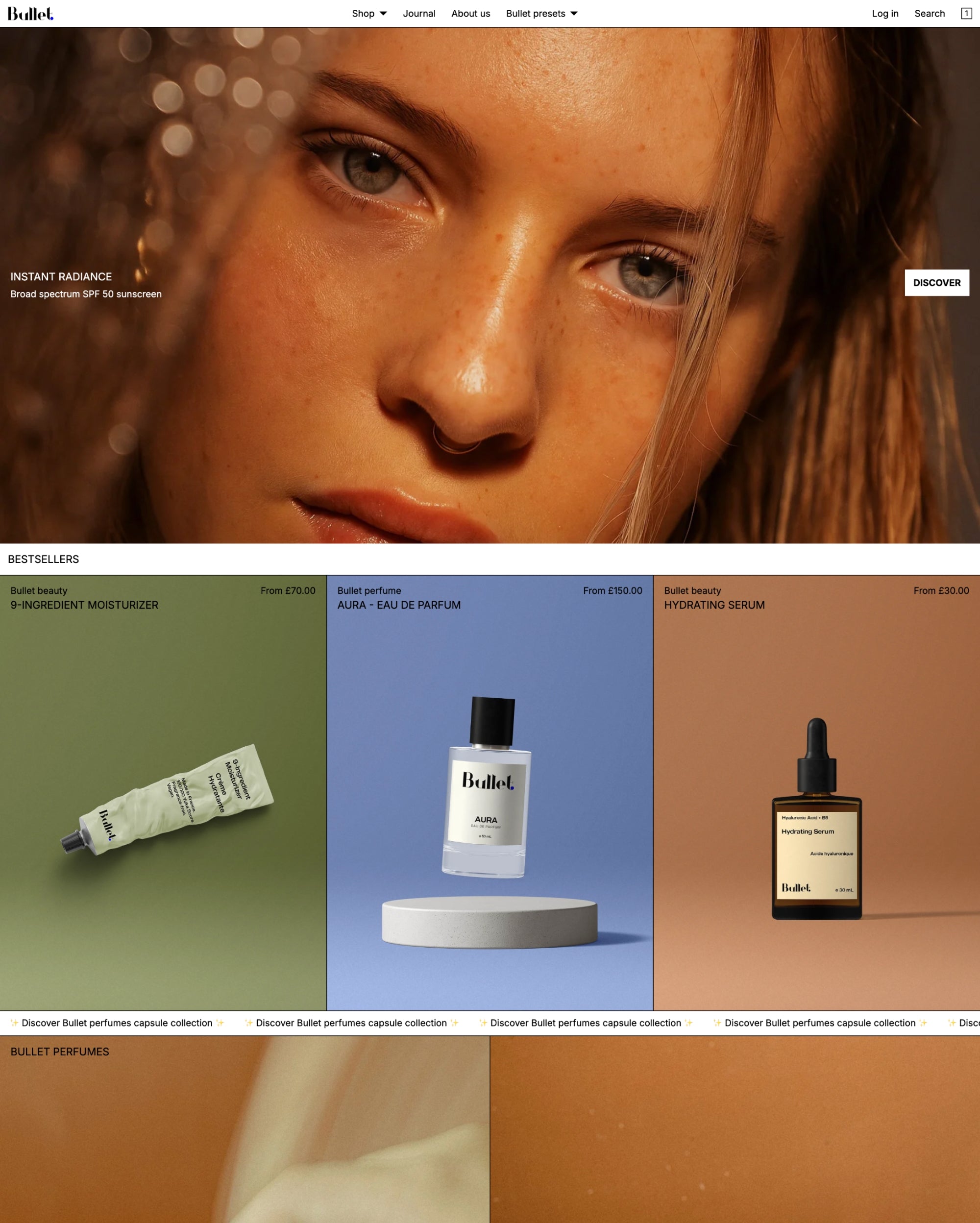
Bullet is listed on the Shopify Theme Store as built for beauty brands, and the feature set backs that up. The listing includes before/after image sliders, color swatches, image zoom, product tabs, ingredient information sections, lookbooks, quick buy, sticky cart, trust badges, countdown timers, recommended products, and swatch filters.
That list matters because beauty brands don’t just need a fast homepage. They need product pages that tell a story, mobile controls that don’t fight the shopper, and visual merchandising that works without bolting on three extra apps.
The speed is real
Bullet currently sits at 94% CWV pass rate on Shopify Performance. On Theme Vitals, the latest mobile figure is 87%.
That puts it ahead of Prestige (Vogue), Ceramide, Phenomena, Be Yours, Wonder, Sleek, and Eurus on at least one of these datasets. Some themes like Stretch benchmark well on raw CWV too, but speed alone doesn’t tell you whether the theme can handle what a beauty store actually needs to do on a product page.
It beats the themes beauty merchants usually compare
When beauty brands shop for themes, they tend to compare Be Yours, Wonder, Sleek, Eurus, Prestige (Vogue), and newer beauty-first options like Glaze because those show up a lot in theme store browsing and comparison articles. On current data, Bullet outperforms most of them on Shopify’s aggregated dataset and stays ahead of many on Theme Vitals mobile.
This matters because nobody picks a theme in isolation. You’re comparing a handful of polished options that all look fine in a demo. Bullet doesn’t make you trade as much between how the store looks, how the product pages function, and how fast everything loads.
The built-in tools are where it pulls ahead
Plenty of themes can be fast when there’s nothing on the page. The question is whether you still have room for swatches, image-heavy product pages, ingredient tabs, trust content, before/after comparisons, good mobile cart behavior, and editorial layouts without immediately reaching for extra apps.
Bullet ships with the features beauty merchants end up needing anyway. Fewer apps, less JavaScript, a cleaner foundation.
It’s currently $370 on the Shopify Theme Store. Version 6.0.0, released February 17, 2026, added 6 new languages (20 total), 8 new sections, and performance improvements. Details are in the Shopify Theme Store listing and the preset page with version notes.
Sense: good free starting point, limited for beauty
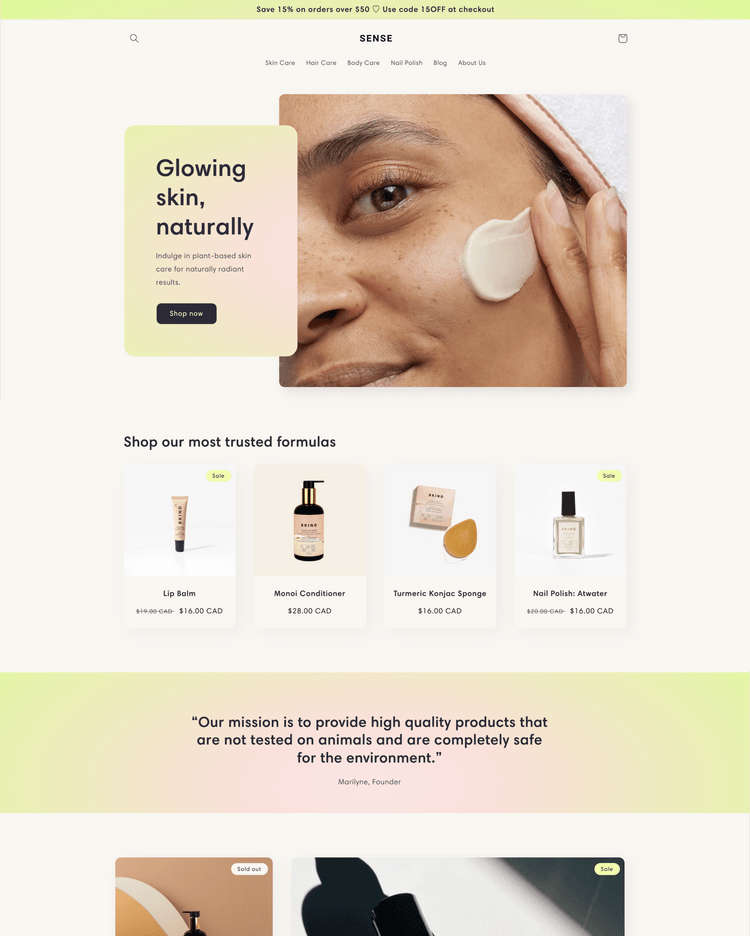
Sense (Dawn) is still the safest free Shopify theme. Simple, well-documented, lightweight. Current numbers: 82.7% CWV pass rate on Shopify Performance, 82.8% mobile on Theme Vitals.
Fine for an early-stage brand still figuring things out. But it’s generic. Compared to Bullet, it has less built-in beauty merchandising and usually needs more customization before it feels like a beauty store rather than a general Shopify store.
Pitch: the best free beauty-friendly option
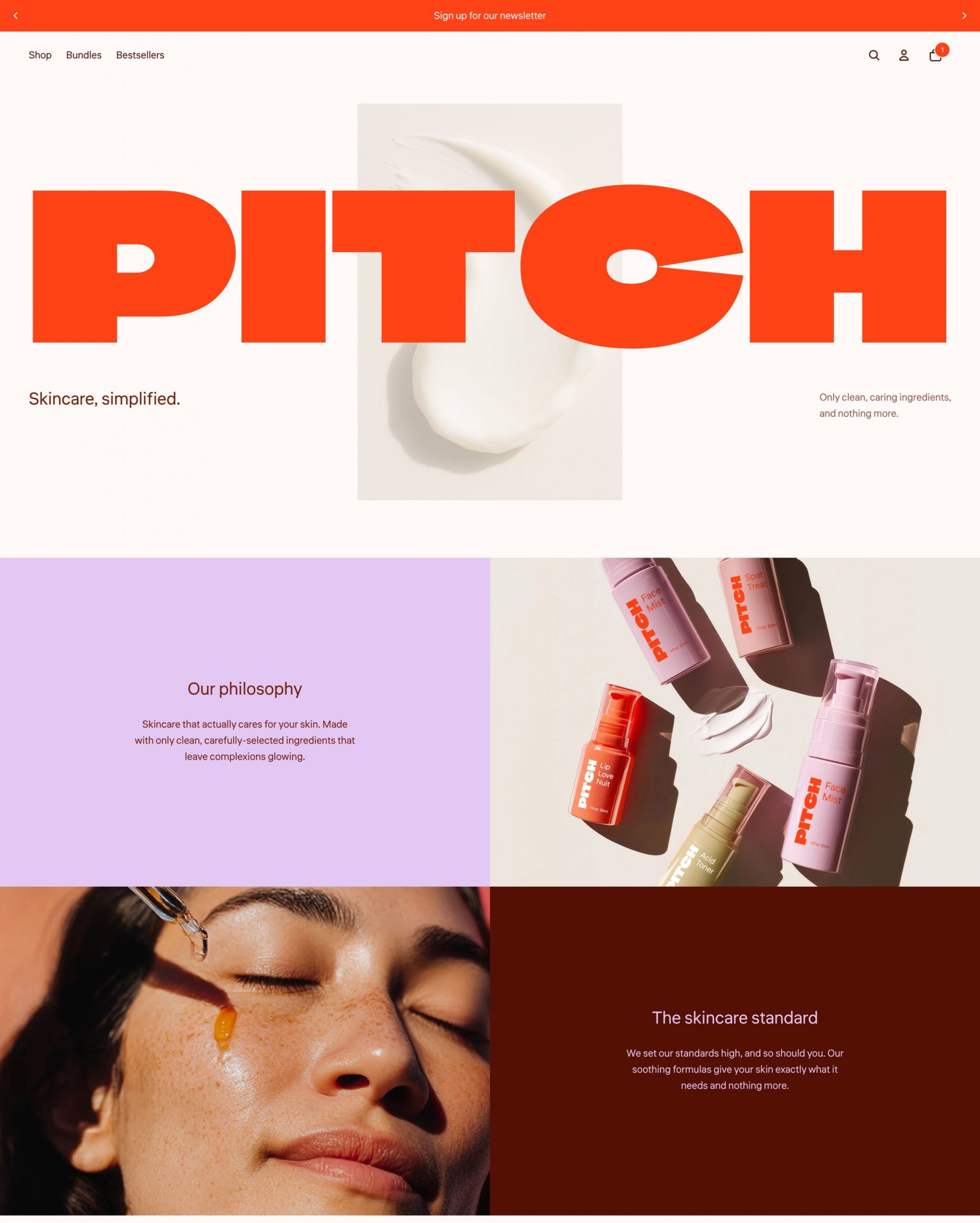
Pitch (Horizon) is worth a look if you want beauty-specific features without paying for a premium theme. Shopify’s own description says it can help merchants highlight ingredients and benefits and showcase shades with color swatches.
Numbers: 82% on Shopify Performance, 92% mobile on Theme Vitals. Better than a lot of merchants realize.
Good launchpad. Not a long-term solution for a brand that’s scaling and wants to avoid app sprawl.
Other themes beauty merchants look at
If you only compare “popular Shopify themes,” you’ll end up evaluating a lot of templates that can be made to work for beauty, but aren’t actually built around beauty merchandising.
The themes below are all tagged for Beauty in the Shopify Theme Store’s Beauty category, so you’re comparing like-for-like presets instead of generic multipurpose demos.
Vogue (Prestige): best for luxury skincare & fragrance
Prestige is the “editorial luxury” pick. The Vogue preset is explicitly positioned for beauty and wellness, which shows up in how it handles large imagery, typography, and brand-led storytelling. If your conversion path depends on education (ingredients, routines, hero benefits) and you’re okay budgeting time to keep the site lean, Prestige can be a great fit.
Where it loses to Bullet: you’ll usually have to be more disciplined with animations, media, and apps to protect mobile speed.
Ceramide (Hyper): best for scaling catalogs and bundles
Ceramide (part of Hyper) is positioned as a theme “for scaling beauty brands with premium polish.” It’s a good match for brands with a growing catalog (multiple concerns, routines, product families) that need strong collection discovery plus upsell and bundle-oriented merchandising.
If you’re running sets, regimen builders, or frequent “buy more, save more” mechanics, Ceramide is worth a serious look.
Phenomena (Palo alto): best for skincare education & brand storytelling
Phenomena is a Palo Alto preset that leans into editorial content: long-form sections, brand narrative, and landing pages that feel less “store template” and more “brand site.” That’s ideal for skincare lines that sell on education (ingredients, clinical proof, routines) and want content-rich PDPs.
Like Prestige, it rewards restraint: keep media optimized and avoid stacking heavy apps.
Be Yours: flexible all-rounder for mid-market beauty
Be Yours is popular because it’s flexible and quick to launch with. You can build routine pages, ingredient explainers, and campaign landing pages without custom templates. Watch your performance budget as you add reviews, subscriptions, and personalization scripts.
Wonder: strong visuals, but mind the CWV trade-off
Wonder is great for brands that win on photography and video. It can look premium quickly, but it’s also easy to create heavy pages. If you pick Wonder, commit to image compression, modern formats, and a tight PDP information hierarchy.
Sleek & Eurus: modern, configurable, “builder” style themes
Sleek and Eurus show up often in Beauty browsing because they offer lots of sections and configuration options. That’s useful for campaign pages and routine guides, but it also gives teams more ways to accidentally ship bloated pages. They work best with a simple content system and restraint.
Stretch: elite raw speed and a valid beauty option — if you configure the PDP right
Stretch is also listed under the Shopify Theme Store’s Beauty category, and its Core Web Vitals performance is excellent. The real question isn’t whether it’s fast — it is — it’s whether your beauty-specific PDP UX is covered without bolting on extra apps.
If you sell shade-based products, complex ingredient education, or routine-driven cross-sells, make sure Stretch can deliver: (1) swatches that feel native, (2) ingredient/benefit content via metafield-driven tabs or accordions, and (3) “routine” merchandising blocks without extra script weight. When Stretch needs multiple apps to become “beauty-ready,” its speed advantage can disappear.
Also worth browsing in the Beauty category: Purity ($300) and Luxe ($490) — both are Beauty-tagged and can fit brands with a more minimal or luxury-heavy design direction.
My recommendation for most beauty brands
If you are trying to choose the best Shopify theme for beauty products, you are usually balancing three things: speed, product page merchandising, and how many apps you will need to bolt on later.
For most serious beauty brands (skincare, cosmetics, fragrance, wellness) that are past the testing phase, I keep landing on Bullet. It is fast enough in real-world data, and it gives you the beauty-specific building blocks that reduce app dependency: swatches, tabs/ingredient sections, lookbook-style layouts, and strong mobile purchase UX.
When I would not pick Bullet: if you are still validating and need free, start with Dawn or Pitch. If your entire brief is editorial storytelling and you are comfortable paying the performance tax with a disciplined app stack, Prestige can make sense. If speed is the only KPI you care about and you are willing to build beauty UX yourself, Stretch is a legit option.
But if your goal is to grow without turning your storefront into a fragile pile of apps, Bullet is the cleanest premium path.
Mistakes I keep seeing
Choosing based on how the demo homepage looks. A polished demo doesn’t tell you anything about product page storytelling, mobile purchase UX, or performance under real merchandising pressure. Every demo looks good. That’s the point of a demo.
Ignoring mobile speed. For beauty, speed affects trust and readability and limits how much content you can actually put on a product page before the experience degrades. Shopify’s documentation is clear that apps and custom code erode performance quickly, which makes a stronger base theme worth more than most merchants think.
Using apps as a substitute for what the theme should already do. Apps can patch missing features, but they also add JavaScript, maintenance overhead, and fragility. If the theme already handles the basics natively, you’re starting from a better place.
FAQ
What is the best Shopify theme for beauty products in 2026?
If you want the shortest answer: Bullet is the best all-round premium pick for most beauty brands because it stays fast while covering the non-negotiable merchandising features (swatches, tabs/ingredients, editorial layouts, mobile cart UX). If you need free, Pitch is the best beauty-friendly starting point, and Dawn is the safe generic baseline.
Who should NOT buy Bullet?
Do not buy Bullet if you are still validating product-market fit, your catalog is tiny, and you do not care about merchandising yet. Start free and keep the burn rate low. Also skip Bullet if your brand requires a highly custom PDP flow (builder, subscription-first, complex bundles) and you already know you are doing heavy custom development anyway. In that case, the theme matters less than the build quality.
What are the best affordable personalization platforms for Shopify beauty brands under 50k visitors monthly?
Under 50k monthly visitors, you usually want lightweight tools that do not add a ton of script weight. A common stack is: (1) email/SMS personalization (Klaviyo segments + onsite forms), (2) product recommendations/upsells at checkout or cart, and (3) a quiz if you sell routines. The right choice depends on whether your biggest lever is routine discovery (quiz), AOV (bundles/upsells), or retention (email/SMS).
Will a faster theme actually improve conversion for beauty?
Sometimes yes, sometimes it just stops the bleeding. Beauty pages are heavy: imagery, video, reviews, ingredient content. A faster base theme gives you more room to add what beauty shoppers need without wrecking mobile UX. If your store is already fast, the bigger gain often comes from simplifying the product page and tightening your information hierarchy.
Should I use apps for swatches, tabs, and bundles?
Use apps when you need something genuinely different. But for basics like swatches, tabs, and simple cross-sells, native theme features usually win: less JavaScript, fewer updates to manage, fewer weird conflicts. Beauty stores are where app stacks go to die. The cleaner your foundation, the longer it stays clean.
How hard is it to switch themes later?
Harder than people expect. Content (pages, products) moves easily, but the real pain is rebuilding templates, sections, metafields, navigation patterns, and all the little conversion details. If you are already selling, picking a theme that will last 18-24 months is worth more than saving a few hundred dollars.
Last updated: March 06, 2026.More posts
- Free Shopify themes vs Premium: When should you upgrade? (2026)
- Best Shopify Theme for Beauty Brands (2026 Guide)
- Which is the best theme in Shopify?
- Etheryx: The Ultimate Premium Shopify Theme
- 10 Things Your Shopify Store Needs to Convert in 10 Seconds
- International E-commerce Expansion: How to Take Your Shopify Store Global


